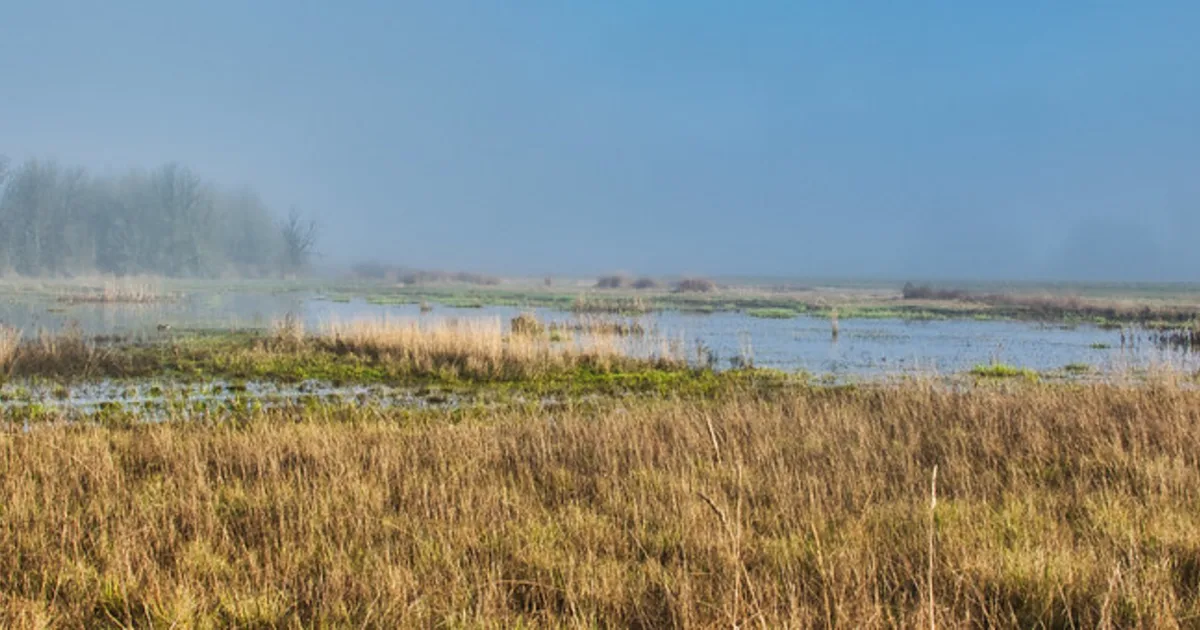
The label is everywhere now: nature-based solutions, natural flood management, green infrastructure. Behind the branding sits a coherent and old idea. If you let a catchment slow, store, and spread water the way an intact landscape does, less of it arrives at once at the places people care about. The engineering question is how much that buys you, and where.
Nature-based solutions for flooding cover a range of interventions, but most share a mechanism. Rather than moving water through faster, they hold it back: floodplain reconnection, wetland and washland storage, riparian planting, leaky woody barriers in headwater streams, and upstream soil and land management that improves infiltration. The common effect is to flatten and delay the flood hydrograph rather than to raise a wall against it.
What the mechanism actually does
Reconnecting a river to its floodplain gives a flood somewhere to go. When high flows can spill across a wide surface, the peak downstream is lower and arrives later, because volume is being stored temporarily and released slowly. Wetlands and washlands do the same thing deliberately. Upstream, better infiltration and roughness mean a given rainfall produces less rapid runoff. These are real, physically grounded effects, and they appear in monitored catchments.
Where the limits are
The honest practitioner caveat is scale. Storage that meaningfully clips a moderate flood can be overwhelmed by an extreme one, because finite storage fills and then passes flow through much as before. Effects also attenuate downstream and can be hard to detect in a large basin. And the benefit depends on landscape condition that is not fixed.
That last point connects to the day's water news. Recent reporting on the upper Great Lakes notes that severe wildfire can make soils hydrophobic, cutting infiltration and driving erosion and runoff into lakes once vegetation no longer filters it. The same loss of catchment function that harms water quality also undercuts the runoff-slowing benefit nature-based flood measures rely on. Separately, reporting on the water-quality cost of large-scale corn ethanol is a reminder that land use upstream sets the baseline a catchment starts from. Nature-based flood work does not happen on a blank slate; it happens on land whose condition is already being shaped by fire, agriculture, and policy.
How to use them well
The defensible position treats nature-based measures as part of a portfolio rather than a slogan. A few practitioner habits make the difference:
- Be explicit about the design event. State the return period the measure is sized for, and accept it will be overtopped beyond that. Our explainer on recurrence intervals and the 100-year flood is the language for this.
- Model at the right scale. Catchment-wide storage benefits need basin-scale hydrologic modelling, not a reach-scale assumption scaled up by hope.
- Account for catchment trajectory. Where wildfire, drainage, or intensive land use is degrading infiltration, build that into the baseline rather than assuming a healthy landscape.
- Give the river room. Reconnection works with how a channel wants to behave; our piece on channel patterns and their controls covers why fighting that tendency tends to fail.
Used this way, nature-based solutions earn their place. They reduce risk for the common events, deliver water-quality and habitat benefits that grey infrastructure does not, and buy resilience as conditions change. They are a layer in the defence, not a substitute for clear-eyed engineering of the rare and dangerous events.